


 IMPLANTS – THE GREAT DISCOVERY IN DENTISTRY
Everything was reconsidered. What yesterday represented a standard, today is outdated. It is typical that in certain specialties in medicine to encounter a great progress at one point.
A dream of the dentistry is that after losing a tooth we could grow a new one in its place. For the fulfillment of this dream, for example by implanting a tooth bud leading to the growth of new natural tooth, it seems that we are still far behind.
In the field of implantation of artificial roots made of titanium remarkable progress has been achieved in recent years. In the past 25 years there is still a doubt that these so called implants can be assimilated by the body, and if so, they may be required prosthetically and that they will last over time. Meanwhile there are several million implants inserted for many years and which are assimilated to the full satisfaction of patients. The constructive possibilities of the denture implants are vast. Very grateful are patients who have had a hard time bearing with an unstable denture.
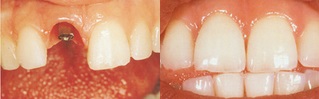
In the past the only solution for treating a final stage edentation (when behind it there was no supportive tooth) was a mobile denture, but today we can use fixed works (bridges) with anchoring in implants. Also, for edentations surrounded by healthy teeth it is avoided, due to the implants, to polish them since we can replace each lost tooth individually.
Also durability, the implant success in time is continuously improving. Current statistics speaks of an assimilation rate of the implants of 90% after 10 years. The design and the surface structure of the implants are constantly improved and perfected which favors the continued growth of assimilation and the duration of their integration. Therefore, there are already cases of the first implants inserted which after 30 years they still fulfill their role of supporting dentures.
Now they may be implanted in almost any clinical situation. 15 years ago the “insufficient bone” situation was an absolute contraindication. By bone plasty and membrane technology today we can successfully perform implants also in such difficult cases.
OPERATION ACT
An important step before the artificial roots implantation, is the surgery plan. First, we precisely establish both the shape and the thickness of the maxilla available. For that, imprints are made on the basis of a radiographically sized sample. With its help we execute a panoramic radiograph that facilitates an accurate measurement of the bone size.
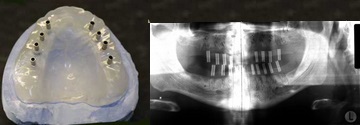 From the beginning there is a close collaboration with the dental technician who ultimately will manufacture the supporting construction suitable for the implants. The dentist together with the technician will determine the optimal position of the implants after analyzing the maxilla imprints. In the next phase the technician will manufacture a milling template that will be used to insert the implants.
The surgery itself can be made by using instruments gracefully and precisely calibrated, minimally traumatic and noninvasive. After taking off the gum, we prepare the place of the implant with rotating instruments precisely calibrated into the maxilla bone. Finally, the implant will be inserted and the gums will be tightly sutured. Within 2 to 6 months the implant fused with the maxilla bone and we can apply the prosthetic part. The healingperiod (osseointegration) varies from individual to individual depending on the bone density or the topographical area where it is implanted, so in the mandible the bone structure is denser than in the maxilla and here the healing is much faster. During the healing period we can maintain the physiognomic function with a temporary work.
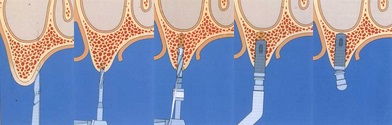 At the end of the healing phase we prepare the implant communication orifice with the mouth through the gum, and imprints are made through the conventional method for prosthetics support constructions. The communication orifice of the implant will be conformed in a way that that the metal is not visible. The insertion of the prosthetic support construction made in the laboratory finished the treatment.
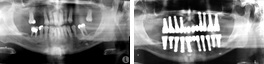 Today we have the opportunity to implant in almost any clinical situation, or quantity of remaining bone, and to insert esthetic ceramic crowns that are indistinguishable from natural teeth. In this regard we successfully practice mouth microsurgical techniques so the aesthetics of the “red” (gum) is given the same importance as to the aesthetics of the “whites” (tooth), the tooth-gum junction being at the optimum level.
The condition of keeping the integrity of the implant is a perfect hygiene of the support construction and of the place of emergence at the level of the gum. When using these sleaning skills, the Sirona Clinic’s qualified personnel is at your disposal.
SINUS LIFT
The sinus lift is often the only implant solution in the lateral maxilla area when the atrophy of the bone reached critical level, thus eliminating the alternative of mobilizable partial dentures that extends over the palate (roof of the mouth). This surgery is primarily beneficial to the patients who have lost all molars in the lateral maxilla or bilateral maxilla, and who still want a fixed prosthetic work.
The aim of this intervention is to create a sufficient amount of bone for the implant. Because the bone plasty, by which the alveolar ridge is raised, has no sense and it often fails, the partial filling of the maxillary sinus is the current most widely used and successful method.
After teeth loss, the sinus extends into the area where their roots were and the bone that supported these teeth is reasorbed. This area will be filled with their own bone (harvested from the same patient) and/or mineral bone and we insert the implants. Their own bone we usually harvest it from the area immediately adjacent to the area of the implant. Very often it is not necessary to harvest bone, the mineral bone newly found leads most times the same good result. The mineral bone used by us faithfully copies the chemical composition of the human bone and it is constituted over the next few months into post-implantation bone by the new formation.
The operative technique is relatively simple, but the execution due to the fragile neighboring anatomical structures is more difficult and requires a lot of finesse in themanagement of the tissue.
In our clinic following method was settled in time: we take off at the gum strictly at the place of implantation. The bone wall of the maxillary sinus newly uncovered under the gum will cut, under absolute protection for thensinus membrane, on a surface of around 5 to 10 mm and removed.
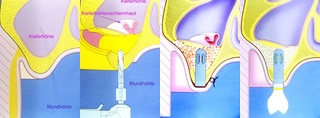 With special tools for this purpose, the membrane will now be pushed inwards, thus keeping sinus integrity and function uncompromised.
Therefore, now we have a space between the alveolar bone and the sinus membrane that will be filled with own bone and/or mineral bone, and the implants will be inserted based on the technique already described. In some clinical situations it is necessary to also widenin the alveolar ridge. For this processwe add their own bone harvested earlier and/or the mineral bone to the lateral side of the alveolar ridge, and then cover it with a special membrane that will protect the bone plasty from the invasion of the epithelial or connective cells that would jeopardize the new bone formation where it is desired to. Where appropriate, we use rezorbable or non-resorbable membranes, which subsequently must be removed.
After about 6 months, in extreme cases after about a year, on the implants may be inserted through the usual technique, the final crowns. This procedure is of a low risk, but sometimes a crack can occur in the sinus membrane which favors a sinus infection because this crack is a communication between the maxillary sinus and the oral cavity. In this case, the intervention is interrupted and we proceed to suture the sinus mucosa. Act implantation operation being resumed after an interval of time needed for the sinus mucosa to heal. For us the sinus lift is an indispensable work, with very good prognosis in most of the treated cases.


